⏰ WEBINAR ATTENDEE EXCLUSIVE
Use coupon code WEBINAR50 at checkout for 50% off
Your price: £147 (instead of the standard £297)
This code expires in
Only available to webinar attendees
For UK Mid-Market Executives Ready to Capitalise on
Africa’s 2026
Industrial Renaissance
185 Pages of De-Risked, Actionable Market Intelligence for C-Suite Executives, Export Managers, Trade Finance Teams, and Investment Professionals
Why 2026 Is Different: The Convergence
Most firms still think of Africa as ‘frontier risk’ and ‘consumer apps.’ They’re positioning for the wrong opportunity.
In 2026, three structural forces converge for the first time:
AfCFTA Category B Trigger (January 1, 2026): ‘Sensitive goods’ begin tariff phase-downs, unlocking duty-free re-export across 54 countries from strategic hub nations.
EU Carbon Border Adjustment Mechanism (CBAM): Makes raw exports less competitive, accelerating local beneficiation (cocoa grinding, lithium refining, textile finishing).
Pan-African Payment and Settlement System (PAPSS): Settling in Nigerian Naira (NGN, ₦), Ghanaian Cedi (GHS, ₵), Kenyan Shilling (KES, KSh), Egyptian Pound (EGP, E£), Moroccan Dirham (MAD, د.م.), and other African currencies—structurally lowering FX costs and counterparty risk.
This isn’t another ‘Africa rising’ narrative. This is infrastructure convergence creating mispriced industrial optionality.

However, there is a cost for waiting:
Your competitors are positioning now. Morocco’s green hydrogen supply chains, Tanzania’s graphite refining, Kenya’s manufacturing-for-export hubs—these aren’t speculative. They’re operational. And UK mid-cap firms who move in Q1 2026 with the proper guidance will capture margins that won’t exist by Q4.
What This Report Actually Contains (Not Theory—Actionable Intelligence)
Here's the level of strategic insight you'll find across this 185-page report:


INSIGHT #1: Why Consumer Fintech Has Peaked
INSIGHT #2: The Midstream Processing Gold Rush
Most UK firms still chase consumer fintech plays in Nigeria and Kenya. But margin compression, regulatory saturation, and winner-takes-all dynamics mean that window closed in 2024.
The new growth core: B2B rails, logistics tech, and industrial SaaS.
Lagos and Nairobi logistics platforms reduced delivery times for UK exporters by 30-40%, enabling SMEs to bypass legacy port agents entirely.
→ Full case study in Chapter 1, page 12
Everyone talks about critical minerals extraction. But the real margin capture is in local beneficiation: lithium refining (Ghana, Zimbabwe), graphite processing (Tanzania, Mozambique).
Tanzania graphite refining doubled local value capture.
UK firms outcompeted Chinese OEMs in quality-sensitive processing stages by offering precision machinery, green chemistry, and battery-grade standards.
→ Full case study in Chapter 1, page 17

INSIGHT #3: Green Hydrogen's Southern Superpowers
While most firms focus on West African oil, the real 2026 opportunity is Morocco and Namibia's low-cost green hydrogen production—driven by exceptional solar irradiation, land availability, and proximity to EU demand.
The UK opportunity isn't energy generation—it's supply chains: Electrolysers, grid-balancing software, battery storage systems, and certification services. Morocco's Noor Solar Complex already demonstrates how UK EPC firms and component suppliers can capture recurring revenue.
→ Full analysis in Chapter 1, page 10
INSIGHT #4: The Risk Paradox
(Statistically Safer Than You Think)
Africa's infrastructure default rate: 5.5%
Latin America's infrastructure default rate: 12%
Political noise ≠ balance sheet reality.
Africa's debt structure is more conservative than most emerging markets. Yet Moody's mispricing persists—creating arbitrage for informed investors.
→ Full risk mitigation framework in Chapter 2, page 21
NOT SURE YET?
EVALUATE OUR RESEARCH QUALITY FIRST
See our research methodology and strategic framework for yourself, then decide.
What's Inside The 2026 Pan-African Opportunity Report
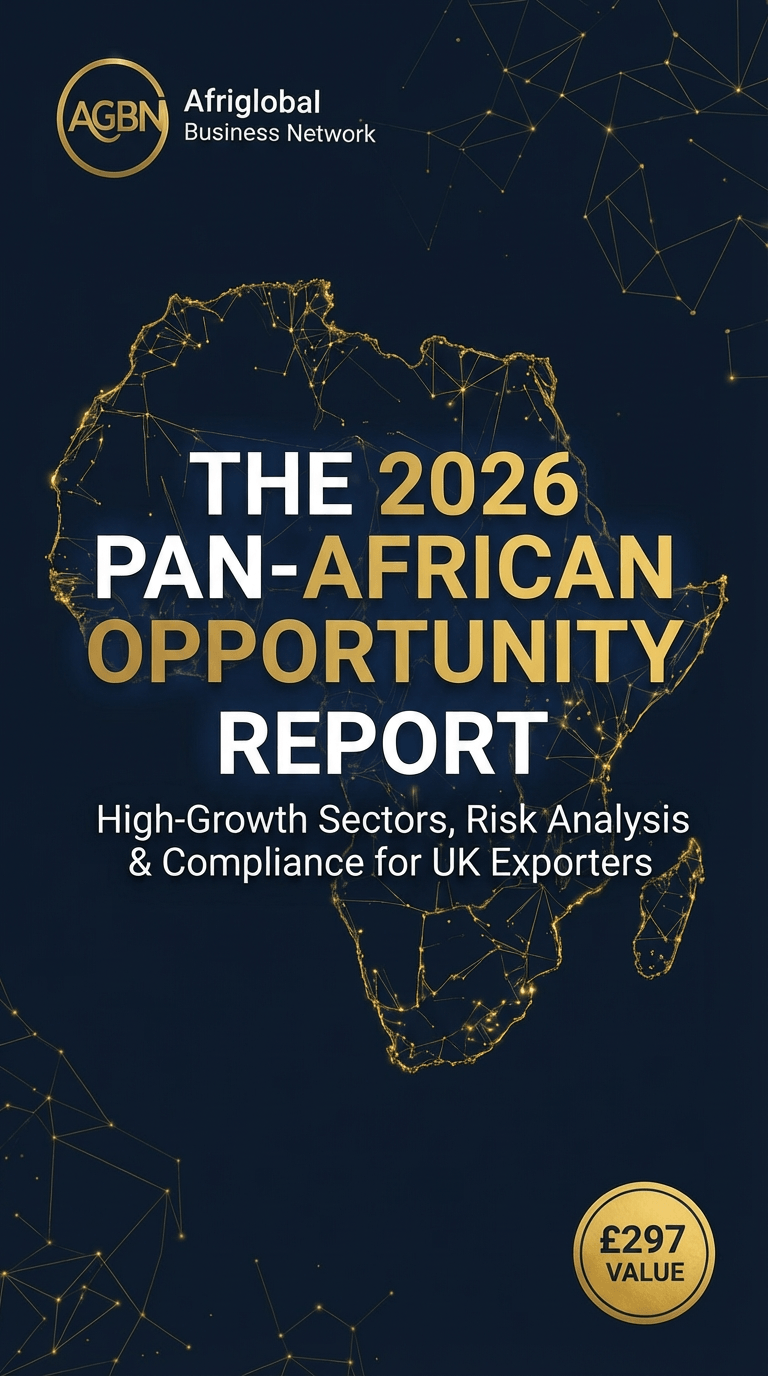
Executive Framing: Why 2026 Is Different
Three converging forces create a once-in-a-decade structural break: AfCFTA Category B tariff triggers activate 1 January 2026, EU's Carbon Border Adjustment Mechanism reshapes supply chains, and Pan-African Payment Settlement System expansion eliminates USD dependency. This isn't speculation—it's regulatory architecture already locked in.
Chapter 1: The Industrial Renaissance — Where UK SMEs Fit
African markets are pivoting from consumer apps to B2B infrastructure: logistics tech, agri-processing machinery, green hydrogen supply chains, and critical mineral midstream processing. Includes case studies from Nigeria, Kenya, Rwanda, Ghana, Morocco, and Tanzania showing exactly where UK expertise in precision engineering, compliance software, and cold-chain systems creates immediate value.
Chapter 2: The 2026 Trade Architecture — Risk, Finance & Digital Rails
Detailed analysis of AfCFTA's three-category tariff system and why Category B matters most, multi-source data proving African default rates are statistically lower than perceived, plus actionable guidance on UKEF navigation, blended finance models, PAPSS integration, and practical blockchain applications (stablecoins, tokenised assets, NFT provenance tools) that reduce counterparty risk without cryptocurrency speculation.
Chapter 3: The Thames Valley Africa Global Bridge — AGBN's Unreplicable Model
How certified cultural brokers solve the "informal-to-institutional" gap that kills most UK-Africa deals, three engagement models (task-based, advisory, equity partnerships) with real anonymised case studies, compliance frameworks that become competitive advantages, and the Strategic Partner investment model (£25K-£100K equity stakes) that gives UK SMEs governance rights in continental market access infrastructure.
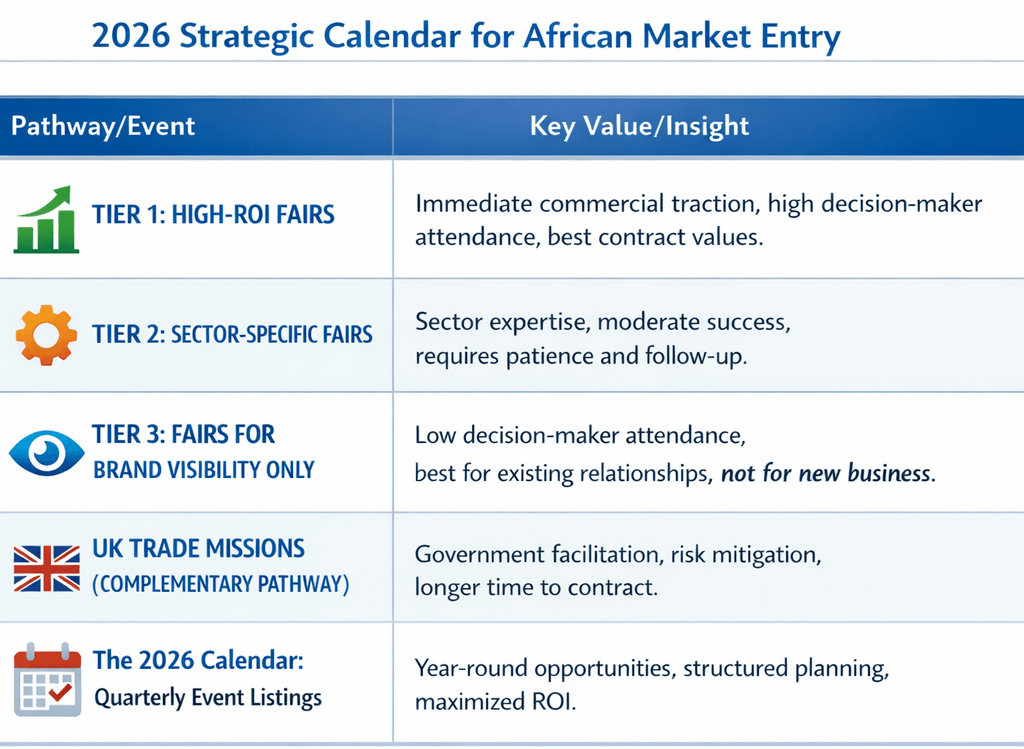
Chapter 4: The 2026 Strategic Calendar — Where Deals Actually Close
Tier-ranked trade fair analysis based on UKEF channel data and cross-referenced intelligence: which events produce signed contracts versus vanity visibility, quarterly listings for Q1-Q4 2026 with sector-specific ROI assessments, plus AGBN's fair attendance support packages that combine pre-vetted introductions, on-ground cultural navigation, and post-event deal structuring to maximize conversion rates.
2026 Strategic Calendar: Know Where Deals Close Before You Book Flights
Stop Wasting Budget on the Wrong Trade Fairs
Most UK exporters treat African trade fairs like lottery tickets—expensive bets with unpredictable returns. This calendar changes that equation entirely.
What Makes This Different:
Cross-referenced intelligence from UKEF channel data, diaspora network deal-flow analysis, and on-ground commercial intelligence creates a tier-ranked system you won't find in government trade briefings. We tell you which fairs produce signed contracts versus which ones are expensive networking theatre.
Quarterly Breakdown January-December 2026:
Cross-referenced intelligence from UKEF channel data, diaspora network deal-flow analysis, and on-ground commercial intelligence creates a tier-ranked system you won't find in government trade briefings. We tell you which fairs produce signed contracts versus which ones are expensive networking theatre.
The Hidden Value:
Timing matters as much as attendance. The calendar maps events against AfCFTA Category B implementation milestones, government fiscal years, and seasonal cash-flow patterns that affect purchasing decisions. Arrive when buyers have budget authority and operational urgency—not when they're gathering brochures for future consideration.
Bottom Line: Save £15,000-£40,000 in misdirected fair attendance by knowing which four events actually matter for your sector in 2026.
Become One of Our Happy Report Readers

We'll be adding testimonials from early readers here soon. Purchase the report now at the introductory rate and you could be featured as one of our founding reviewers.

UK exporters and diaspora professionals are already using this intelligence to plan their 2026 Africa strategy. Be among the first to access the report—your insights could appear here.

Early readers are discovering which trade fairs actually convert and which regulatory shifts create immediate opportunities. Join them and share your experience.

Testimonials from verified report purchasers will appear here. As a new intelligence product, we're building this section with feedback from UK SME directors, diaspora business leaders, and trade finance professionals actively working UK-Africa corridors.
Everything you need to navigate UK-Africa trade in 2026 and beyond:
industrial opportunities, trade architecture, cultural broker access, and the complete strategic calendar.
One payment, full intelligence report packge.
If you have been given a coupon code, enter it in the payment form for your discount.
Frequently Asked Questions
Established consultancies sell you what they already know—recycled desk research repackaged as bespoke analysis. AGBN exists because the UK-Africa intelligence gap isn't a knowledge problem, it's an access problem.
We're not competing with McKinsey's Africa practice. We're solving the problem McKinsey doesn't address: the mid-cap UK exporter who can't afford £50,000 for a market entry study but needs more than a government trade briefing.
This report synthesizes cross-referenced data from UKEF channel analysis, on-ground diaspora commercial intelligence, and regulatory architecture that becomes actionable in January 2026—not theoretical frameworks about "future potential." The cultural broker network backing this intelligence has closed deals in these markets. The question isn't our track record, it's whether you want intelligence shaped by people who've actually navigated UK Bribery Act compliance in Lagos or prefer polished PowerPoints from consultants who've never cleared a container through Mombasa.
Quality assurance: If you identify factual errors or material misrepresentations in the report, contact us with specifics. We'll issue verified corrections to all purchasers—our credibility depends on accuracy, not volume.
Fair challenge. Here's what "practical" actually means in UK-Africa trade:
You don't need another guide telling you "build relationships" or "understand the culture." You need to know that AfCFTA Category B tariff triggers activate 1 January 2026, creating regulatory arbitrage opportunities through Kenyan SEZs that didn't exist in 2025. You need the tier-ranked trade fair calendar showing which Q2 event attracts procurement officers with budget authority versus which Q3 fair is expensive brand theatre.
Chapter 3 details three engagement models with cultural brokers—task-based, advisory, equity partnerships—with anonymised case studies showing deal structures, payment terms, and circumvention safeguards. Chapter 2 includes hedging decision frameworks for frontier currency exposure and ERP integration guides for PAPSS settlement.
The "how-to" is embedded in understanding why the trade architecture matters. Once you see why PAPSS reduces counterparty risk structurally, the implementation pathway becomes obvious. We're not writing a manual for assembling flat-pack furniture—we're giving you the commercial logic that lets you adapt to ground realities your competitors won't recognize until 2027.
You absolutely should use government resources—UKEF, DBT sector briefings, FCDO market assessments. They're pretty good.
What they don't do: tell you that Tier 3 trade fairs waste your budget, explain why diaspora-led joint ventures statistically fail less than consultant-brokered deals, or provide the regulatory arbitrage playbook for combining SEZ tax treatment with AfCFTA market access.
More importantly, government resources can't solve the core execution problem in UK-Africa trade:
How do you access diaspora commercial networks without getting burned by the "trusted local partner" who vanishes after the deposit clears? Government tells you diaspora connections matter. This report shows you AGBN's institutional credentialing system that transforms informal diaspora networks into accountable, insured, compliance-trained cultural brokers.
Chapter 3 details the certification framework, three-tier engagement models (task-based, advisory, equity partnerships), and the legal safeguards that prevent deal circumvention. This isn't theory—it's the operational infrastructure that makes "Global Britain" actually function at the mid-cap SME level, not just as ministerial talking points.
Government intelligence tells you to work with diaspora networks. AGBN shows you how to work with them without the statistical failure rates that make most UK exporters abandon African markets after one bad experience.
The strategic calendar alone saves you one misdirected trade fair attendance (£15,000-£25,000 in flights, accommodation, exhibition space, and opportunity cost). The cultural broker credentialing framework solves the single biggest gap between UK policy ambition and private sector execution: turning diaspora social capital into institutional infrastructure that actually closes deals and survives legal scrutiny.
Think of it this way: Government intelligence tells you the road exists. This report gives you the certified drivers who know which exits lead somewhere, the insurance that covers you if they don't, and the contractual frameworks that ensure they can't strand you halfway to your destination.
This is how Global Britain becomes operational reality for companies that can't afford Big Four consultancies—and why this model is unreplicable by competitors who lack 20+ diaspora network partnerships already embedded in UK regions.
Valid concern. Here's what doesn't change versus what requires monitoring:
Locked-in regulatory architecture with multi-year implications (90% of this report):
AfCFTA Category B tariff schedule (activates 1 January 2026, but the analysis shows you how to capitalize on trends unfolding through 2027 and beyond—this isn't just about the trigger date, it's about the 3-5 year structural shift in continental supply chains)
EU Carbon Border Adjustment Mechanism timeline (regulation passed, implementation dates fixed, reshaping African manufacturing for the next decade)
PAPSS Phase 2 expansion (infrastructure deployed, central bank integrations confirmed—the payment rails being built now)
UK Export Finance enhanced Africa capabilities (institutional mandate, not subject to quarterly revision).
The intelligence is designed to be durable: Understanding why Category B matters lets you anticipate second-order effects in 2027-2028 that your competitors won't recognize until they're already playing out. The report explains the structural logic, not just the event calendar.
Dynamic elements requiring monitoring (10% of this report):
Specific trade fair dates/venues (we provide Q1-Q4 2026 framework, you verify final logistics)
FX volatility patterns (we give you hedging decision framework, not prediction)
Individual country political developments (we show you how to decouple project risk from sovereign risk)
The intelligence is structured so the strategic framework remains valid even if specific data points shift. Understanding why Kenya works as a manufacturing hub for AfCFTA market access matters more than knowing today's exact SEZ tax rate—that rate will change, the structural logic won't.
2026 is the inflection point, not the endpoint. The regulatory triggers, trade architecture, and payment infrastructure launching in January create momentum that plays out over years. This report positions you to capitalize on the entire wave, not just the initial splash—while your competitors are still reading 2026 event recaps in 2027.
All sales are final. This is a digital intelligence product delivered immediately upon purchase—once you have access to the complete 185-page report, the transaction is complete.
This isn't a consumer product with a satisfaction guarantee. It's professional-grade commercial intelligence for serious UK-Africa trade participants. You're purchasing access to cross-referenced data, strategic frameworks, and the institutional infrastructure that makes UK-Africa deals actually work.
Before you purchase, be clear on what you're getting:
Executive Framing that demonstrates how immediately actionable the intelligence is
Africa's Industrial Renaissance analysis with UK SME positioning strategy
Complete regulatory and trade architecture analysis for 2026 and beyond
AGBN's unreplicable cultural broker credentialing model for high-performing diaspora-led deals
Three engagement models with deal structure frameworks and legal safeguards
Trade finance de-risking tools and compliance playbooks
Tier-ranked strategic calendar with ROI assessments and conversion data
If you're uncertain whether African markets align with your business model: scroll up and download the FREE 19-page Report Outline, which includes the complete Executive Framing. This shows you exactly how the intelligence is structured and whether the analysis matches your strategic priorities.
If you need bespoke consultation before committing to the report: contact us to discuss a preliminary assessment. Our contact details are inside the free outline document.
The investment here isn't speculative—it's strategic positioning. You're either serious about understanding UK-Africa trade architecture for 2026-2027, or you're still in exploratory mode. This product serves the former. If you're the latter, bookmark this page and return when you're ready to move beyond preliminary research.
No refunds. No exceptions. Purchase with confidence in the intelligence quality, or wait until you're certain this aligns with your strategic priorities.
Have a question that isn't answered here?
Download our free report outline and email us your question.
Our contact details are inside the free report.
You've seen the framework. You understand the timing. The question isn't whether 2026 presents opportunity—it's whether you'll be positioned to capture it while your competitors are still reading government briefings that don't include this level of actionable intelligence.
185 pages of cross-referenced data, tier-ranked trade fairs, real case studies, and the cultural broker network that turns exhibition handshakes into signed contracts.
Single payment. No subscriptions. Full 2026-2027 coverage.
Clicking this button will take you back to the purchase section where pricing is displayed. If you have a coupon code from our webinar or other sources, you can apply it there for your discount. However, coupon availability is limited—the longer you wait, the less likely codes will still be active.
⏰ WEBINAR ATTENDEE EXCLUSIVE
Use coupon code WEBINAR50 at checkout for 50% off
Your price: £147 (instead of the standard £297)
This code expires in
Only available to webinar attendees
Terms & Conditions | Privacy Policy
Afriglobal Business Network Ltd is a company registered in England and Wales with company number 16090568.
Registered office: Reading, England, United Kingdom.
Get Your FREE 19-Page Report Outline
We respect your privacy.
Enter your details to receive the 19-page outline instantly.
No credit card required
Please note: It may take up to 24 hours to receive your outline. Whitelist contact@afriglobalbusiness.net by adding it to your contact list, and check your spam folder if you don't see it. After submitting your details, you can close this window and continue reading.